

Get More Info
A comprehensive guide to Advent traditions
St Catherine’s Day – although this feast day falls during the pre-Advent period, it is associated with a number of preparatory Christmas customs, just like St Martin’s Day; this day was usually filled with merriment and folk dances
-
a demonstration of folk dances and the participants joining in the dancing
-
making Advent wreaths
St Andrew’s Day – this saint was regarded as a powerful protector against evil spirits, and on this day a number of magical rituals relating to fortune-telling were performed
-
fortune-telling using four cups
-
knocking on the henhouse to find a husband
-
searching for the face of one’s future husband
St Barbara’s Day
-
decorating sugar hearts and other gingerbread biscuits
St Nicholas’ Day
-
the arrival of St Nicholas, the devil and the angel, and the traditional St Nicholas gift-giving; the dignified St Nicholas, as well as the other characters, may walk on stilts to heighten the effect
St Lucy’s Day – the name Lucy means ‘full of light’, and on this day a log was set aside to be used to light the Christmas Eve fire; St Lucy also protected against floods, which is why candles were lit in the windows
-
making Christmas candle holders
Christmas Eve and the Christmas season
Christmas Eve is the last day of Advent; it is called ‘Christmas Eve’ in remembrance of the fact that Christianity was given the most precious gift in the form of the Son of God. On this day, the Christmas tree is decorated and a nativity scene is set up beneath it. Folk magic played a very significant role.
-
pouring lead or wax – we’ll tell you what the coming year has in store for you
-
sailing little boats made from walnuts
-
slicing apples
-
shoe-throwing
-
a magic mirror for single women
-
fortune-telling with a scarf to reveal a girl’s virtue
-
fortune-telling using dried months
-
shaking the tree – where will I get married?
-
making chains and snowflakes from rose hips, nuts, etc., or simply from paper
-
cutting out traditional folk-style or Lada-style nativity scenes
-
making hanging angels or poinsettias
-
weaving decorations from straw
-
making figures from rice husks
-
items made from Vizovice dough


INTERACTIVE CHRISTMAS PROGRAM
Christmas customs are among the most popular and interesting traditions, during which old customs were observed in the run-up to Christmas and folk magic played a very significant role. Just as with Easter customs, we have prepared themed “stations” for you focused on various Advent traditions. The program can be tailored to individual Sundays of Advent and important Advent days such as the feasts of St. Lucy, St. Barbara, or St. Andrew.
Our programs are based on the active participation of visitors, not just passive demonstrations. Under our guidance, guests will try out each tradition for themselves—decorating gingerbread cookies, making a candlestick, launching a paper boat, and participating in other customs.
We present individual customs in period costumes from various historical eras, such as medieval or Old Bohemian Christmas. An engaging narrative about the origins of the traditions, their meaning, and symbolism is, of course, also part of the program.
For some activities, variable costs should be expected depending on the amount of materials used (e.g., the number of gingerbread cookies, wreath bases, and other craft materials).
Most Popular Workshops and Creative Activities
-
Lead or wax pouring – we’ll tell you what the coming year holds
-
Floating walnut boats
-
Apple carving
-
Making Advent wreaths (St. Catherine’s Day)
-
Decorating sugar hearts and other gingerbread cookies (St. Barbara’s Day)
-
making Christmas candle holders (St. Lucy’s Day)
-
shoe-throwing
-
making chains and snowflakes from rose hips, nuts, etc., or simply from paper
-
cutting out traditional folk costumes or Lad’s nativity scene
-
making hanging angels or Christmas stars
-
weaving decorations from straw
Fun Advent Characters – A New Christmas Program
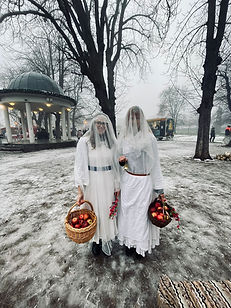
Join us in discovering the mysterious world of Advent characters that have accompanied the pre-Christmas season for centuries. Our new program presents traditional figures rooted in both pagan and Christian customs in a fun and educational way.
You’ll meet St. Nicholas, St. Barbara, St. Lucy, and St. Ambrose—figures who once roamed the villages, rewarding, admonishing, protecting, and ensuring traditions were upheld. Each has its own origins, distinct appearance, and significance—ranging from the symbolism of light and protection to overseeing fasting and good behavior.
The program is complemented by a narrative about the history of Advent, its connection to the winter solstice, and its gradual evolution into today’s four-week period of anticipation leading up to Christmas. Period costumes, captivating stories, and interactive audience participation are all part of the experience.
Join us on a journey back to a time when Advent was not just a countdown to Christmas Eve, but a season full of mystery, symbols, and a magical atmosphere.
Complete Advent traditions
St. Catherine’s Day – although this holiday falls in the pre-Advent period, it is associated with a number of preparatory Christmas customs, just like St. Martin’s Day; this day was usually filled with merriment and folk dances
-
a demonstration of folk dances and audience participation in the dancing festivities
-
making Advent wreaths
St. Andrew’s Day – this saint was considered a powerful protector against evil spirits, and on this day, a number of magical rituals related to fortune-telling were performed
-
fortune-telling using 4 cups
-
knocking on the henhouse to find a husband
-
searching for the face of one’s future husband
St. Barbara’s Day
-
decorating sugar hearts and other gingerbread cookies
St. Nicholas’ Day
-
the arrival of St. Nicholas, the devil, and the angel, along with the traditional St. Nicholas gift-giving; the dignified St. Nicholas, as well as the other characters, may walk on stilts to enhance the effect
St. Lucy’s Day – the name Lucy means “full of light,” and on this day a log was set aside to be used to light the Christmas Eve fire; St. Lucy also protected against floods, which is why candles were lit in the windows
-
making Christmas candle holders
Christmas Eve and the Christmas season
Christmas Eve is the last day of Advent; it is called “Christmas Eve” in memory of the fact that Christianity was given the most precious gift in the form of the Son of God. On this day, the Christmas tree is decorated, and a nativity scene is set up beneath it. Folk magic played a very significant role.
-
pouring lead or wax – we’ll tell you what awaits you next year
-
floating boats made from walnuts
-
cutting apples
-
shoe-throwing
-
magic mirror for singles
-
scarf divination to test a girl’s honesty
-
divination of the dry months
-
shaking the tree – where will I get married?
-
making chains and snowflakes from rose hips, nuts, etc., or simply from paper
-
cutting out traditional folk-style or Lada’s nativity scenes
-
making hanging angels or Christmas stars
-
weaving decorations from straw
-
making figures from corn husks
-
products made from Vizovice dough
Interactive Christmas programme


Advent Characters – a new Christmas programme
Join us in discovering the mysterious world of Advent characters, who have been part of the run-up to Christmas for centuries. Our new programme presents, in an entertaining yet educational way, traditional figures with roots in both pagan and Christian customs.
You’ll meet St Nicholas, the Barbors, St Lucy and St Ambrose – figures who once roamed the villages, rewarding, admonishing, protecting and ensuring that traditions were upheld. Each has their own origins, distinctive appearance and significance – ranging from the symbolism of light and protection to overseeing fasting and good behaviour.
The programme is complemented by a narrative on the history of Advent, its connection to the winter solstice, and its gradual evolution into the four-week period of anticipation leading up to Christmas as we know it today. There will be period costumes, captivating stories and interactive audience participation. Join us on a journey back to a time when Advent was not merely a countdown to Christmas Eve, but a period full of mystery, symbols and a magical atmosphere.